



A Sleek Frameless Design Can Hide Optical and Safety Weaknesses
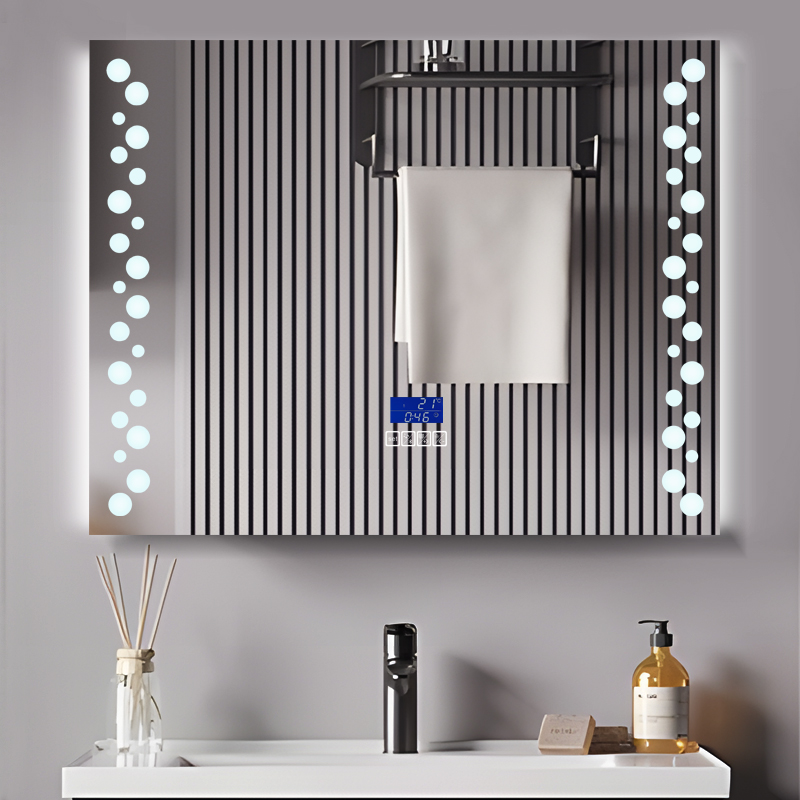
A frameless bathroom mirror with lights can appear sleek while hiding serious optical, mechanical, and electrical weaknesses. Exposed glass edges may chip, uneven LED spacing can create bright dots and dark corners, and poorly protected wiring can face condensation behind the mirror. These defects lead to returns, unsafe handling, failed inspections, and expensive site replacements. A combined edge-illumination and safety review checks the glass, diffuser, LED layout, backing, mounting, moisture protection, temperature, wiring, and controls as one system before production, helping project buyers protect both appearance and long-term reliability.
The best frameless illuminated mirror combines finished safety glass, uniform edge or perimeter lighting, protected wiring, suitable moisture resistance, controlled temperatures, secure mounting, and accessible servicing. Our company develops Customizable OEM and ODM mirrors through coordinated optical, mechanical, electrical, environmental, and packaging reviews.
Define What Edge Illumination Means
Edge illumination can describe several different constructions. Buyers should identify the exact lighting method rather than relying on a general product name.
Common Frameless Lighting Constructions
- Front-lighted perimeter with a frosted or etched band
- Backlight emitted around the outside glass edge
- Light introduced through the glass edge and extracted through a treated area
- Combined front and rear illumination
- Side-mounted LED channels concealed behind the mirror
Each construction produces a different visual effect, face illumination, wall glow, product depth, thermal condition, and service requirement.
Decorative Light Versus Task Light
A backlit halo may create an attractive floating effect without providing enough forward light for shaving or makeup. A front-lighted band directs more light toward the user but must control glare and visible LED points.
The Supplier should state whether the product is intended as decorative lighting, task lighting, or a combination of both.
Set Measurable Lighting Requirements
| Lighting Parameter | Specification Question | Failure to Prevent |
|---|---|---|
| Brightness | What useful illuminance reaches the face at the intended distance? | A bright-looking mirror that provides weak grooming light |
| Uniformity | How consistent is the illuminated band around straight sections and corners? | Dark zones, bright spots, and uneven borders |
| Color temperature | Is the CCT fixed or selectable, and what tolerance applies? | Visible color differences between mirrors or LED sections |
| Color rendering | What CRI, red-rendering, or other color-quality data are required? | Unnatural skin, makeup, and hair appearance |
| Glare | Can users see exposed LED points or excessive brightness? | Visual discomfort at normal viewing positions |
| Flicker | Is output stable at full and dimmed settings? | Eye discomfort, video banding, and poor dimming |
| Color consistency | How closely must production units and replacement parts match? | Different-looking mirrors in the same project |
Review the Illuminated Border
Frosted Band Width
The width of the light-transmitting band affects brightness, glare, mirror area, and overall proportions. A narrow band can appear intense, while a wider band may produce softer illumination but reduce the reflective area.
Distance from the Glass Edge
The relationship between the exposed edge, illuminated band, LED strip, and backing affects both appearance and durability. Insufficient clearance can expose LED dots or place wiring too close to vulnerable edges.
Corner Uniformity
Rounded, arched, and irregular mirrors require particular attention at corners and curves. LED strips, rigid boards, diffusers, and reflective materials may not follow every radius evenly.
Border Inspection Points
- Consistent light-band width
- No visible LED points
- No dark corners or connection gaps
- No unexpected color shift around curves
- No scratches or pinholes in the frosted area
- Clean transition between reflective and illuminated surfaces
- Symmetrical border on both sides
Specify the Glass and Edge Finish
A frameless product leaves glass edges visually and physically exposed. Edge quality therefore influences appearance, handling safety, impact resistance, and packaging requirements.
Glass Specification Checklist
- Glass type and thickness
- Applicable safety treatment or retention method
- Polished, ground, beveled, or shaped edge
- Corner radius or custom profile
- Dimensional and squareness tolerances
- Acceptable chips, scratches, waves, and coating defects
- Safety backing coverage
- Hole and cutout details where applicable
The project team should confirm local safety-glazing requirements for the installation. A safety backing film, processed glass, or another retention system should be defined by performance rather than by name alone.
Prevent Edge Chipping
Glass edges may be damaged during fabrication, assembly, packing, transport, or installation. Small chips can weaken the edge and become visually prominent when illuminated.
Edge-Protection Measures
- Use consistent polishing without sharp projections.
- Avoid metal-to-glass contact.
- Use compatible gaskets or spacers at support points.
- Prevent screws and brackets from loading exposed edges.
- Protect corners during factory movement.
- Use nonabrasive perimeter cushioning in the carton.
- Provide clean-glove handling instructions.
Lighting can make defects more visible. Edge inspection should therefore occur with the mirror both switched off and illuminated.
Coordinate LEDs, Diffusers, and Reflective Materials
Uniform illumination depends on the distance between the LEDs and diffuser, LED pitch, optical film, channel geometry, reflective surfaces, and border treatment.
- Define the target illuminated-band appearance.
- Select the LED type, spacing, and mounting direction.
- Set the distance between the LEDs and light-transmitting area.
- Add diffusion and reflection materials as required.
- Build a production-representative optical sample.
- Inspect it from normal and oblique viewing angles.
- Measure brightness, color, and uniformity.
- Approve the complete mirror under actual bathroom lighting.
Increasing LED power alone does not correct poor optical geometry. It may make bright spots, glare, and temperature problems worse.
Check Thermal Performance
LEDs, drivers, demisters, sensors, and enclosed backing structures produce heat. Excessive temperatures can shorten component life, weaken adhesives, discolor diffusers, or affect mirror coatings.
Thermal Review Conditions
- Maximum rated supply voltage
- Highest LED brightness setting
- Demister operating simultaneously
- Warm ambient bathroom conditions
- Final wall clearance and mounting orientation
- All backing covers installed
- Expected ventilation paths unobstructed
Temperatures should be measured at LEDs, drivers, adhesives, wiring, accessible surfaces, and other critical points after stable operation. Acceptance limits should come from component ratings, product requirements, and the destination market.
Complete an Electrical Safety Review
| Safety Area | Review Requirement | Typical Risk |
|---|---|---|
| Supply rating | Correct voltage, frequency, and total power | Overheating or component failure |
| Electrical class | Defined insulation and grounding construction | Electric-shock risk or failed inspection |
| Wiring | Protected routing, suitable insulation, and secure terminals | Pinched, loose, or damaged conductors |
| Driver | Approved component, correct load range, and thermal location | Flicker, noise, overheating, or early failure |
| Moisture protection | Suitable enclosure and cable-entry protection | Water ingress, corrosion, or electrical fault |
| Grounding | Protective continuity where required | Accessible metal becoming hazardous |
| Controls | Safe touch, sensor, dimming, and memory operation | False activation or unstable performance |
| Service access | Safe isolation and component replacement | Unsafe maintenance or complete-mirror replacement |
A licensed electrician should install hardwired mirrors under local wiring rules. Product compliance does not replace compliant bathroom-zone assessment and site installation.
Verify Moisture and Condensation Resistance
Steam and temperature changes can produce condensation on glass, backing, frames, fasteners, drivers, connectors, and sensors. Moisture may enter through cable openings or remain trapped behind the mirror.
Useful Environmental Evaluations
- High-humidity exposure
- Condensation cycling
- Splash or ingress testing appropriate to the product rating
- Corrosion testing for metal components
- Adhesion checks after moisture conditioning
- Electrical and functional tests before and after exposure
Post-Test Inspection Points
- No black edges or reflective-layer deterioration
- No corrosion, blistering, or staining
- No moisture inside protected electrical areas
- No diffuser clouding or adhesive lifting
- No LED flicker or dark sections
- No sensor or demister malfunction
- No unsafe insulation or grounding condition
Review Mounting and Wall Clearance
The mirror, backing, lights, driver, and demister create a complete assembly that must remain securely attached to the wall. Frameless edges also require enough clearance for safe installation and removal.
Mounting Requirements
- Mirror weight and center of gravity
- Approved wall substrate and anchors
- Bracket material, spacing, and load capacity
- Anti-lift or locking feature
- Cable-entry and junction-box position
- Rear ventilation and service clearance
- Permitted wall-flatness tolerance
- Safe removal procedure
The rear-view drawing should be released before electrical and structural rough-in begins. A Wholesaler or contractor should not estimate cable and bracket positions from the front dimensions.
Inspect Touch Controls and Demisters
Touch sensors positioned near an illuminated edge may be affected by moisture, grounding conditions, glass thickness, coatings, or nearby wiring. Demister pads add heat and electrical load behind the mirror.
Functional Test Checklist
- Reliable sensor response with dry and damp glass
- No unintended activation during cleaning
- Visible and durable control icons
- Correct dimming and color-temperature changes
- Expected memory after power interruption
- Uniform demister heating
- No overheating near adhesives or wiring
- Stable operation with all functions active
Approve a Full-Size Golden Sample
A small illuminated glass sample cannot demonstrate full-border uniformity, corner performance, mounting, heat distribution, or control behavior. The buyer should approve a complete production-representative mirror.
Golden Sample Records
- Model and drawing revision
- Glass, edge, and safety-backing details
- LED, diffuser, driver, and control specifications
- Lighting measurement results
- Electrical and environmental test records
- Rear structure and mounting hardware
- Approved packaging construction
- Photographs with lights on and off
Control OEM and ODM Production
Our company can develop Customizable frameless illuminated mirrors through a controlled Manufacturer and Supplier workflow.
- Define the shape, dimensions, lighting purpose, and target market.
- Freeze the glass edge, illuminated band, and rear construction.
- Build a full-size optical and functional sample.
- Evaluate lighting, temperature, moisture, electrical safety, and mounting.
- Approve the golden sample and measurable tolerances.
- Control LEDs, drivers, diffusers, glass, and adhesives by specification.
- Inspect every production batch for edge and lighting defects.
- Repeat qualification after critical design or component changes.
Protect the Mirror During Shipment
Packaging should protect the exposed glass perimeter without pressing against fragile illuminated edges or control areas.
- Use shaped cushioning around the complete perimeter.
- Protect every corner and curved transition.
- Keep accessories away from the glass.
- Prevent movement inside the carton.
- Spread face loads through suitable protective panels.
- Define orientation and stacking limits.
- Validate the complete package for the intended distribution route.
Request an Edge-Illumination Review
Send us your mirror dimensions, lighting effect, functions, mounting conditions, quantity, and target market. Our team will prepare a Customizable OEM or ODM proposal covering glass edges, optical design, electrical safety, moisture testing, mounting, inspection, and packaging. Contact us today to validate your frameless illuminated mirror.



 English
 Español
 Deutsch
 Français
 日本語
 Nederlands
 Português
 한국어
 Italiano
 Svenska